

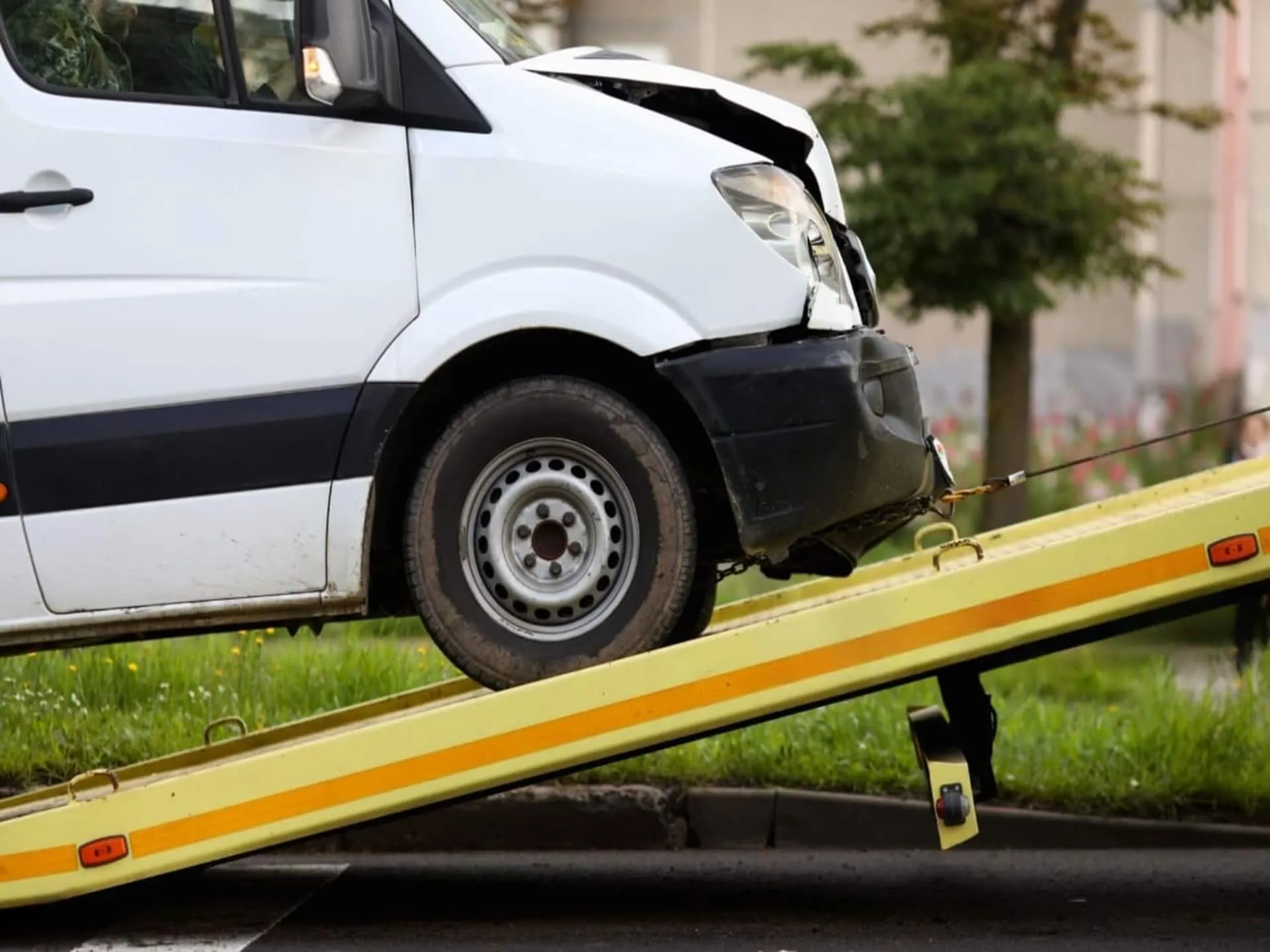
Two questions decide a company-vehicle case
A collision with a company car, a delivery van, a service contractor’s pickup, or a utility truck raises two questions that the crash report does not answer: whether the driver was doing the company’s work at the time, and what the company controlled about the vehicle and the trip. The answers decide whose records exist, whose insurance applies, and whether the review extends beyond the driver to the business that put the vehicle on the road.
We examine the company’s work and control in collisions involving company sedans and SUVs, cargo and delivery vans, fleet pickups, service and utility trucks, and light box trucks. A company vehicle can also be a regulated commercial motor vehicle. Truck accidents cover tractor-trailers and other operations involving carrier records; both sets of questions may apply. Every collision also leaves the ordinary roadway record, from the crash report to vehicle and video evidence. The company records add to that evidence.
Company cars, pickups, vans, and the trucks in between
Whether motor-carrier requirements apply depends on the vehicle’s weight rating, passenger capacity, cargo, the operation, and the applicable rules and exceptions. A trip entirely within Texas can still form part of interstate commerce. The review considers the shipment’s overall movement and the applicable vehicle and operational rules, not simply whether the driver crossed the state line.
Texas also regulates certain intrastate operations under its own applicability rules. Interstate character alone does not establish every recordkeeping duty, and a local route does not exclude one. Driver-qualification files, hours-of-service logs, and inspection records may be required where the relevant rules apply; other useful records may come from the company’s own practices.
The Texas crash report reflects the same distinction. It has a commercial-motor-vehicle section that the investigating officer completes when a vehicle meets a reporting threshold lower than the state’s regulatory one. That section records whether the vehicle was in interstate or intrastate commerce, in government use, or in personal use, and it names the carrier the officer identified, which may be a lessee rather than the registered owner. For a heavier van or a pickup and trailer, it can supply the company’s name and identification number. For a light company car it is usually blank, and the employer is identified from the vehicle’s markings, its registration, and the driver’s own account.
One recent change matters for lighter vehicles. Texas ended the annual safety inspection for non-commercial vehicles at the start of 2025, while vehicles that meet the state’s commercial definition still require one. A company sedan or light van may therefore have no state inspection record, and its maintenance history comes from the company’s own files and the shops it used.
Ownership, control, and the policies behind the vehicle
The vehicle’s owner and the driver’s employer are not always the same organization. A company may own its fleet outright, lease it from a fleet-leasing company, rent vehicles for particular jobs, or expect employees to drive their own cars on company business. In some delivery models the brand on the van, the business that employs the driver, and the owner of the vehicle are three different organizations. Each arrangement produces its own documents, and the review begins by collecting them: the registration and any lease or rental agreement, the employment or contractor agreement, and the company’s written rules about who may drive which vehicle and for what purpose.
Whether a company answers for a collision involving one of its drivers depends on facts such as whether the driver was its employee or an independent contractor, whether the trip was part of the job or a personal errand, and what the company knew about the driver and the vehicle. Texas courts decide those questions from the specific record. That is why the firm asks for the company’s vehicle-use policy, the driver agreement the employee signed, the driving-record checks the company ran, and its crash-reporting and maintenance practices. Guidance that OSHA and the National Highway Traffic Safety Administration publish for employers describes those documents as ordinary features of a workplace driving program. That guidance is not a regulation, but the presence or absence of those documents says something about how the company managed its vehicles.
Fleet telematics, dispatch apps, and delivery records
Company vehicles may carry systems that record more than the vehicle’s own event data recorder. Fleet telematics can log location, speed, hard braking and acceleration, seat-belt use, idling, and fault codes, and some systems generate an automatic collision alert with the seconds of data around the impact. Dispatch and routing software records where the driver was sent and when, and delivery scanners and route apps record each stop. Dash cameras, including inward-facing ones, may record the drive. Whether a given vehicle had any of these, and what it retained, is a question for the company, and the answer cannot be assumed from the vehicle’s appearance.
These records are company property, governed by the company’s retention practices and by the legal process that applies to records held by another party. The firm identifies the vehicle by its unit or fleet number, photographs the door-jamb plate that shows its weight rating, and sends a written preservation request to the company before the vehicle is repaired, returned to service, or sold. A dispatch app or a delivery scanner in the driver’s hands at the moment of impact also bears on attention, and the evidence of distracted driving is reviewed separately.
Insurance follows the vehicle and the trip
Texas requires financial responsibility for each privately operated vehicle on its roads, and a business may meet that requirement through a commercial auto policy, a fleet policy, or, for larger fleets, self-insurance under state rules. A collision involving a company vehicle may therefore involve a policy that is not written in the driver’s name at all. When an employee drives a personal car on company business, more than one policy can be involved: the driver’s own policy and, if the employer carries it, coverage for vehicles the business hires or does not own. Which policy responds first, and for what, is answered by the policies’ own language and by the facts of the trip, not by the fact that the driver was working.
Delivery, service, and sales trips across Houston
Many of the business vehicles on Houston roads are not freight carriers at all. They are parcel and food delivery vans on residential routes, service contractors’ pickups moving between job sites, utility trucks, sales representatives’ leased sedans, and company vehicles assigned to employees who also drive them home. Each kind of trip leaves its own trail. A delivery route has stop-by-stop scans, a service call has a work order and a schedule, and a sales trip has a calendar and an expense record. The question of whether the driver was working is usually answered from that trail rather than from the driver’s memory.
Collisions involving Houston police and fire department vehicles are investigated by the Houston Police Department’s Vehicular Crimes Division, the same division responsible for fatal collisions and failure-to-stop cases, so a collision with one of those vehicles produces a file in a specific place. Records for other public fleets sit with the agency that operates them and are requested through the public-records process rather than from a private insurer.
Government and utility vehicles are a separate question
Collisions involving a governmental vehicle may be subject to different notice, immunity, party, and procedural rules depending on the governmental entity and the facts. Federal vehicles, including Postal Service vehicles, may involve a separate federal administrative-claim process. Those questions are evaluated separately from the rules that apply to a private company, and this page does not imply that the firm accepts every governmental or federal vehicle matter.
Utility trucks operated by private companies raise the same company-vehicle questions. One operated by a public entity follows the public rules. Buses, including transit buses, are reviewed separately.
Hand-offs to neighboring pages
Several neighboring questions take over when the facts change.
- A driver working through a platform app rather than for an employer is a rideshare accident, and Alto is a rideshare service that describes company-operated vehicles and employee drivers.
- When a van or company truck struck from behind, the sequence of the collision is reviewed as a rear-end accident; we also investigate the company behind it.
- A company driver injured in the vehicle has a workplace injury, whose questions begin with the employer’s coverage status.
- A death in a company-vehicle collision adds the family and estate questions of a wrongful death claim.
Before the firm reviews a company-vehicle collision
Bring what identifies the company. Photographs of the vehicle’s markings, unit numbers, and license plate, the crash report, the driver’s name and employer if they were given at the scene, and any card or insurance information the driver handed over let Leatherwood & Schindler identify the company, request the records it holds, and form its view of responsibility from that record rather than from the logo on the door. A consultation starts there.