

The rider’s account and the driver’s account are both tested against the record
A motorcycle collision produces the same roadway record that any serious collision produces: the crash report, the responding agency’s file, video from nearby cameras, and the damage to the vehicles. Which Houston-area agencies hold that record, and why it is requested early, is the same for any serious car accident. The rider and the motorcycle also leave evidence that needs its own review.
Two things change. The physical evidence has to explain not only what the vehicles did but what the rider could see, do, and withstand, because a motorcycle has no structure around the person on it. And the accounts are uneven. A driver who is uninjured can describe the collision at the scene. A rider who is taken to a hospital may not describe it for days, and the first version of events in the report may be the driver’s alone. The review treats both accounts as claims to be tested against the skid and scuff marks, the resting positions of the motorcycle and the rider, the damage on each vehicle, and whatever the cameras and witnesses recorded.
Texas law compares the conduct of everyone involved. The fact that one party was on a motorcycle is not a finding about responsibility in either direction. The firm does not begin from the assumption that the rider was reckless, and it does not begin from the assumption that the rider had the right of way.
Left turns, lane changes, and the driver who did not see the motorcycle
Texas requires a driver turning left at an intersection or into an alley, private road, or driveway to yield to an oncoming vehicle that is in the intersection or close enough to be an immediate hazard. On a roadway divided into marked lanes, it requires every driver to stay as nearly as practical within a single lane and to move from it only when the movement can be made safely. Those duties apply to a driver turning across or moving into the path of a motorcycle exactly as they apply with a car. Whether the motorcycle was an immediate hazard, whether the lane change could be made safely, and whether the driver looked are questions of fact, answered from sight lines, speeds, lighting, and the positions of the vehicles rather than from the kind of vehicle involved.
The National Transportation Safety Board’s 2018 report on the causes of motorcycle crashes describes what it calls a perception failure by the other driver, meaning a failure to detect the motorcycle or to recognize that a dangerous situation existed, as a documented factor in multi-vehicle motorcycle crashes, with a turning vehicle at an intersection, alley, or driveway as a typical setting. That finding describes a pattern across crashes. It is not evidence about any particular collision, and the firm establishes what a particular driver could see from the scene itself: the driver’s position, the obstructions, the lighting, the motorcycle’s headlamp, and the time the motorcycle was in view.
The Texas Department of Transportation’s motorcycle campaign, Share the Road: Look Twice for Motorcycles, asks drivers to look twice at intersections and before left turns and lane changes. That is safety messaging, not a legal standard. The legal duties are the yield and lane rules above.
Full use of a lane and the 2023 rule on riding between lanes
Since September 1, 2023, Texas law has stated the lane rules for motorcycles in a single section. A motorcycle is entitled to the full use of a lane, and a motor vehicle may not be driven in a way that deprives it of that use. Two motorcycles may ride side by side in one lane. A motorcyclist may not ride between lanes of traffic moving in the same direction and may not pass a vehicle while sharing its lane, with an exception for police officers performing their duties. Riding between lanes, sometimes called lane splitting or filtering, is therefore prohibited under the statute’s text, and the firm states the rule from that text rather than from the way riders in other states describe the practice.
A violation of a lane rule by either party is evidence, not a conclusion. Whether a driver crowded a motorcycle out of its lane, or a rider was between lanes when a car drifted or a door opened, is established from the same physical and video record described above. How any violation bears on responsibility is a question counsel evaluates on the facts.
Surface conditions, braking, and what the motorcycle itself shows
A motorcycle responds to the roadway differently from a car. Loose gravel, a spilled load, grooved pavement in a construction zone, steel plates, a painted marking in the rain, or an uneven seam between lanes can affect a motorcycle’s traction and stability in ways a car does not register. Braking is different as well. On a conventional motorcycle the front and rear brakes are controlled separately, by hand and by foot, and a hard stop on two wheels carries risks a car’s does not. When surface condition or braking is part of the account, the review documents the pavement as it was that day, identifies who was responsible for the roadway or the work zone, and reads the marks the tires left.
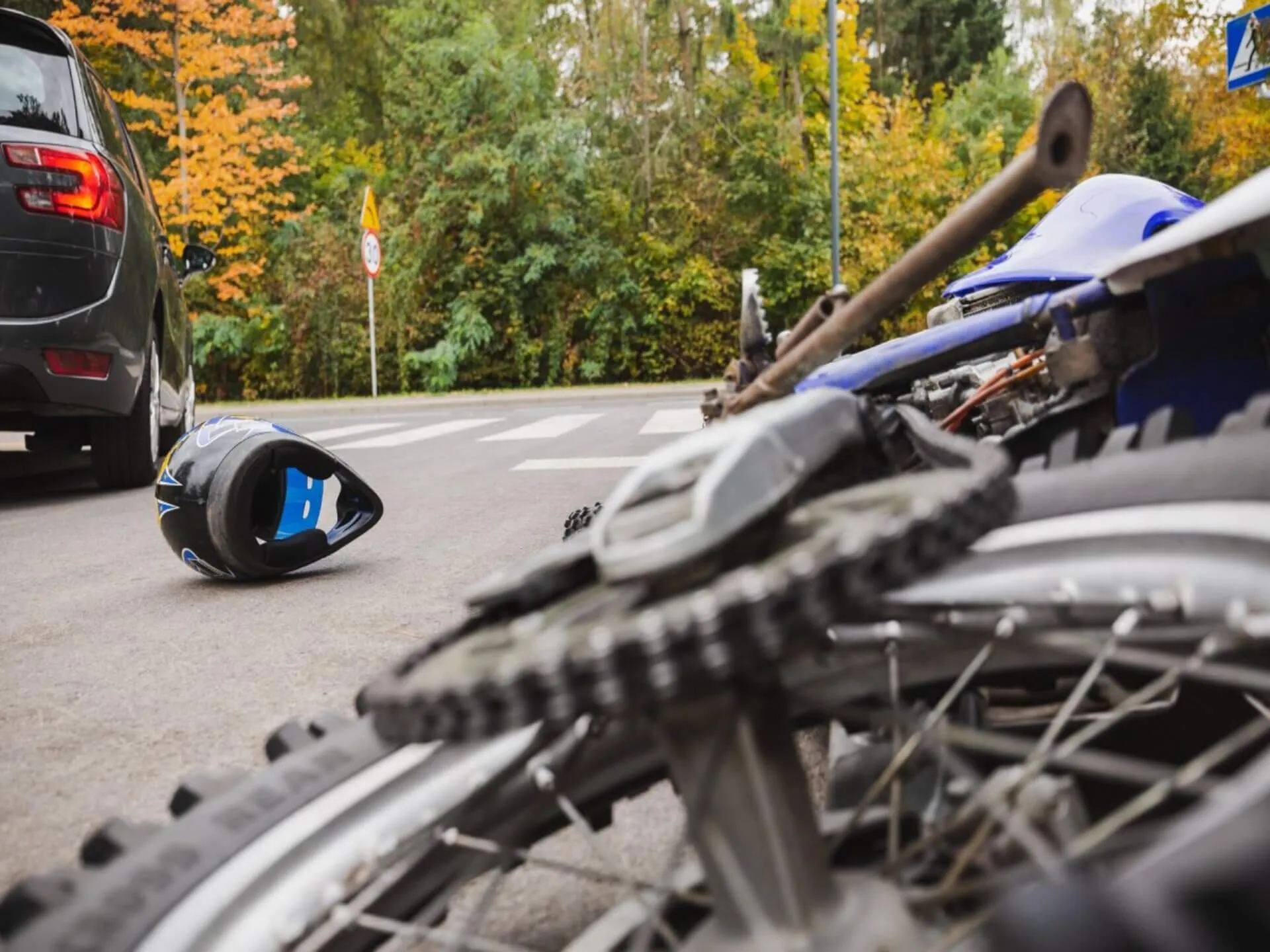
The motorcycle is evidence. Where it came to rest, the scrapes and gouges along its side and along the pavement, the crush and contact points, the condition of the tires and brakes, the position of the controls, and the state of the headlamp are examined before the motorcycle goes to a repair shop, a salvage buyer, or an insurer’s lot. Some motorcycles carry electronic modules, such as anti-lock braking systems, that store limited data. Whether a particular motorcycle recorded anything is a question for inspection, not assumption. With no state safety inspection of non-commercial vehicles since the start of 2025, a motorcycle’s maintenance history comes from the owner and the shops that serviced it.
The other vehicle carries evidence too. The height and location of the contact damage show where the motorcycle struck or was struck, and a passenger vehicle’s event data recorder may add the driver’s inputs in the seconds before impact.
Helmets, licensing, and training as part of the record, not as verdicts
Texas requires a motorcycle operator and passenger on a public street or highway to wear protective headgear that meets standards adopted by the Department of Public Safety. The law creates an exception for a rider who is at least 21 and has either completed an approved motorcycle operator training and safety course or is covered by a health insurance plan that pays for injuries from a motorcycle collision, and it bars an officer from stopping a rider solely to check for that course or insurance. Whether a helmet was worn, and whether it was damaged, is recorded on the Texas crash report for every motorcyclist involved.
The helmet law says nothing about how helmet use is treated in a civil claim. The helmet, or its absence, is part of the record: the helmet itself, its damage, and the medical records of a head injury or the absence of one. How that evidence bears on a claim depends on the injuries actually sustained and is a question counsel evaluates. It does not decide who caused the collision, and it does not eliminate a claim.
Licensing works the same way. Texas requires a Class M license, or a motorcycle authorization on another class of Texas license, to operate a motorcycle, and an original license or authorization requires completing a motorcycle operator training course approved under state law and taught through schools licensed by the Texas Department of Licensing and Regulation, with an exception for riders already licensed for motorcycles by another state. The rider’s license status and training history are records the Department of Public Safety and the training school hold, and the other side will ask about them. They describe the rider’s qualifications. They do not establish how the collision happened, which is a separate question answered from the scene.
Witnesses, video, and a rider who cannot yet speak
Because the rider may be unable to give an account at the scene, the accounts of others carry more weight early. Witnesses who saw the motorcycle’s position and speed, other drivers with dash cameras, the business and home cameras that face the intersection, and the rider’s own helmet or handlebar camera, if one was mounted, each capture part of the seconds before impact. Video is identified quickly because camera systems keep footage only briefly. For a motorcycle collision the same steps apply, with one difference: a family member or friend may need to take them while the rider is in the hospital. Ask for the crash report number, photograph the motorcycle and the gear before anything is repaired or discarded, and write down the names of anyone who stopped.
Motorcycles and commercial trucks
A motorcycle struck by, or striking, a tractor-trailer, tanker, or other commercial truck raises the carrier questions of a truck accident. A truck has blind spots to its sides and directly ahead and behind that a car does not, and whether the driver checked them before a lane change or turn is examined from the truck’s own data and cameras where they exist. The rider’s actions and the motorcycle’s condition also need review. A driver who was working in a company car, van, or pickup at the time brings in the employer and its dispatch and telematics records, as in any commercial vehicle accident.
Pedestrians, bicyclists, scooter riders, and the other pages
A motorcycle can also be the vehicle that strikes someone. When a motorcyclist collides with a pedestrian, a bicyclist, or a scooter rider, the injured person’s questions are reviewed under those collisions, and the motorcyclist’s conduct also needs review. When a driver’s attention is the question, the phone, vehicle, and video records of distracted driving show it. If the rider did not survive, a wrongful death claim raises the family and estate questions that follow, while the reconstruction described here continues as the event record.
Talking with the firm after a motorcycle collision
What exists now is enough to start: the crash report number, photographs of the motorcycle, the helmet, and the gear, the names of witnesses, any letters from an insurer, and the medical records to date. If the rider cannot take part yet, a family member can bring those to a consultation. Leatherwood & Schindler will identify the records that need to be requested and preserved, explain the questions the collision raises, and say plainly what the evidence shows.