

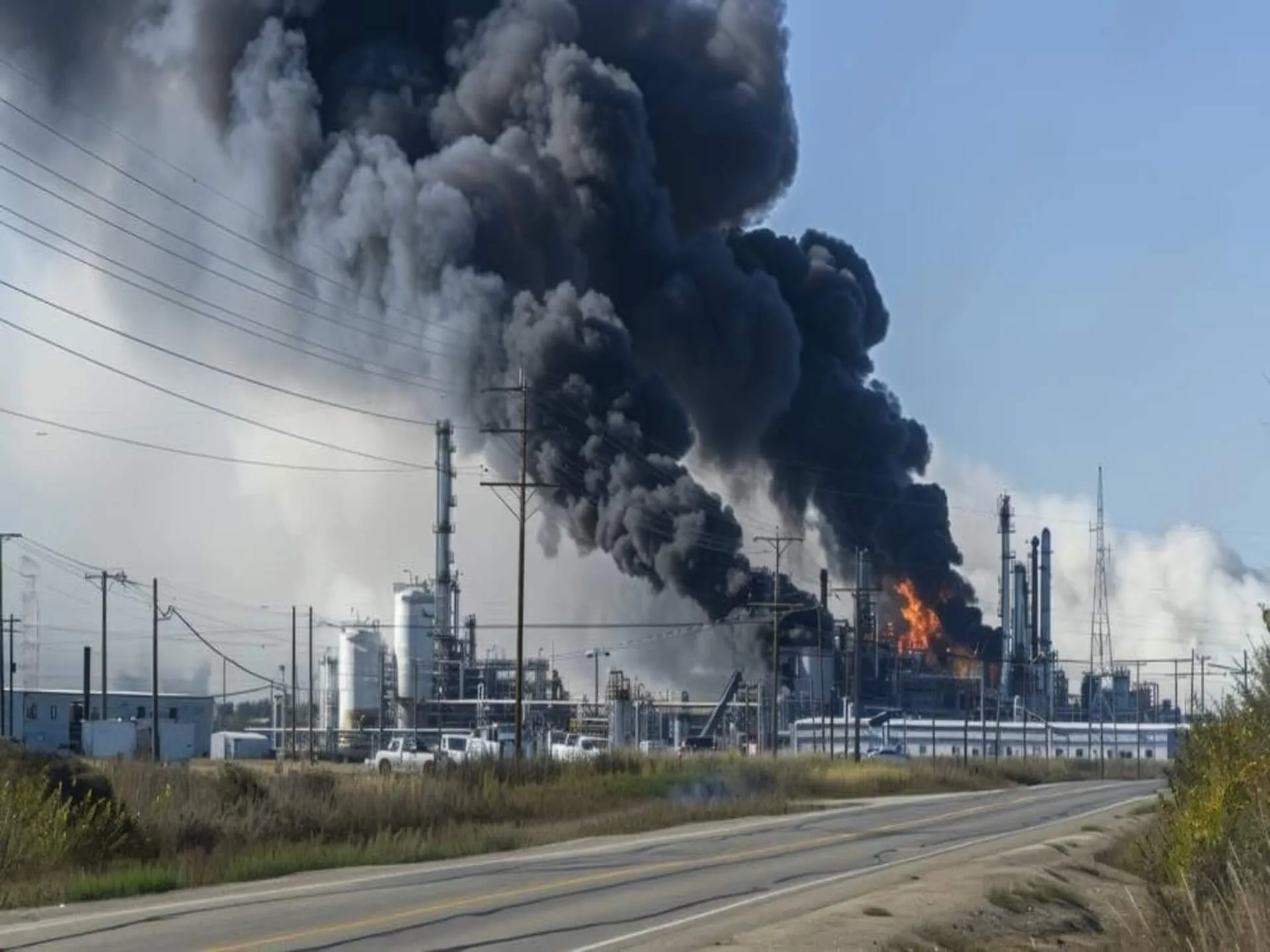
Refineries, chemical plants, and other process facilities
We handle injuries inside refineries, petrochemical and chemical plants, and similar facilities that run continuous processes under pressure and temperature, whether the injured person was a plant employee, a contractor’s employee working a maintenance job or a turnaround, or a driver or vendor inside the gate. We examine how the facility is organized, which companies work inside it, and which records it keeps to establish what happened and who was involved.
Three kinds of event that happen at plants are reviewed separately. An explosion or flash fire is reviewed for its mechanism. A release that was inhaled or contacted without igniting is a chemical exposure injury. Burns are reviewed for their medical course. Onshore wells, pads, and tank batteries are oilfield accidents; the federal process-safety rule itself excludes oil and gas well drilling and servicing, which is one reason the two settings are reviewed differently. A vessel or dock incident at a plant’s marine terminal is a maritime accident, and a tanker collision at the plant gate is a truck accident.
Turnarounds bring contractors into the plant
A turnaround is a planned shutdown of a process unit for inspection, maintenance, and repair. It brings a large contract workforce into the plant on a compressed schedule, often into units the workers do not see between turnarounds, and it concentrates the activities that process-safety rules regulate most closely: hot work, confined-space entry, the opening of equipment that held process fluids, temporary changes to procedures, and the restart of the unit afterward. Routine maintenance outside a turnaround involves the same permits on a smaller scale.
Many of the people doing that work are employed by scaffolding, insulation, pipefitting, welding, electrical, instrumentation, inspection, and general maintenance contractors, sometimes through staffing companies, under contracts with the facility operator or host employer that assign scopes of work and allocate risk. The injured worker’s employer, the host employer, the property owner, the company that issued the permit, and the company that isolated the equipment may be different companies, and each is reviewed separately. Which of them stands inside the workers’ compensation relationship and which is a third party is asked for each company.
Process safety management and the records it requires
Process safety management is the federal workplace safety rule that applies to a process handling a listed highly hazardous chemical at or above a threshold quantity, or a flammable liquid or gas in large quantities, with exceptions the rule itself lists. Its purpose is prevention, and it works by requiring the relevant process employer to create and keep documents. Those documents are the spine of a refinery review because they record what the process employer knew about a hazard and what it had decided to do about it before the incident.
The rule requires process safety information about the chemicals, the technology, and the equipment; process hazard analyses, which the facility must keep for the life of the process; written operating procedures; operator training with periodic refreshers; provisions for contractors; a pre-startup safety review before a new or changed process runs; a mechanical-integrity program with inspection and test records; a hot work permit for welding, cutting, and similar work on or near a covered process; a management-of-change procedure for changes to chemicals, technology, equipment, or procedures; an incident investigation for each incident that resulted in, or could reasonably have resulted in, a catastrophic release; an emergency action plan for the plant; and a compliance audit at regular intervals. Related general-industry rules govern permit-required confined spaces, the control of hazardous energy through lockout and isolation, and fire watches during hot work.
Whether a departure from any of these requirements bears on responsibility is a question counsel answers from the whole record, not from the rule alone. Equally, a facility that kept every record may still have made the decisions that the records describe.
Contract workers and the host employer
The facility operator or host employer controls the covered process, process-area access, permits, and process-safety records. That company may or may not be the property owner. Under the process-safety rule, the relevant host employer must obtain and evaluate information about a contractor’s safety performance before selecting it, inform the contractor of the known fire, explosion, and toxic-release hazards of the process and of the emergency action plan, control the entrance, presence, and exit of contract employees in covered process areas, periodically evaluate the contractor’s performance, and maintain a log of contract-employee injuries and illnesses related to work in process areas. The contractor, in turn, must train its employees in safe work practices and in the hazards of the process, document that each employee received and understood the training, and tell the host employer about any hazards its own work creates or finds.
Those duties matter to a civil review for a practical reason. The Texas rule that limits when a property owner is responsible to a contractor’s employees is examined with third-party claims. The facts relevant to that separate property-owner analysis may be written down in the property owner’s contracts and records and in the host employer’s permits, contractor evaluations, hazard communications, entry controls, and process hazard analyses. The firm requests each record from the company that controls it.
Alarm data, control-system records, and operator logs
A process unit records itself. The distributed control system and its data historian store process variables such as pressures, temperatures, levels, and flows at short intervals; the alarm and event journal records each alarm, its acknowledgment, and each operator action; shift logs and handover notes record what the operators observed; and radio recordings, gate and badge systems, and cameras record who was where. For a specific job, the permit to work, the isolation and lockout records, the confined-space entry permit with its atmospheric test results, the hot work permit with its fire-watch assignment, and the job safety analysis record what was authorized and what was checked.
Much of this is overwritten or archived on a schedule the facility sets. The firm identifies the unit, the date and time, and the tag numbers of the equipment involved as early as possible so that the request for control-system data and permits can be specific, and it asks the facility and each contractor to preserve what they hold.
Agencies whose files describe the facility
Several agencies hold records about a facility and about an incident, and none of them decides a civil claim.
- The Occupational Safety and Health Administration inspects private-sector facilities, runs a national emphasis program directed at facilities covered by the process-safety rule, and keeps an inspection file that can be requested under the Freedom of Information Act.
- The U.S. Chemical Safety and Hazard Investigation Board is an independent, non-regulatory federal agency that investigates selected accidental releases involving a death, a serious injury, or substantial property damage and publishes its reports; facilities must report qualifying releases to the Board within hours of the event. The Board’s role, and the limits federal law places on the use of its findings, are explained with explosions.
- The Texas Commission on Environmental Quality receives an initial notification of a reportable emissions event within a day of discovery and a final report about two weeks after the event ends, and it maintains a public database of those reports, which describe the compounds released, the quantities, and the duration in the facility’s own words.
- The U.S. Environmental Protection Agency’s Risk Management Program requires covered facilities to keep a five-year accident history and an incident-investigation program parallel to the workplace rule; the program’s requirements have been under revision, and counsel confirms the version in force for a given date.
- The Railroad Commission of Texas regulates oil and gas production and pipelines, not refinery process operations; its records can concern intrastate lines feeding and leaving a plant, and its role is described with oilfield accidents.
Each report is the company’s account, made under a duty that exists for safety and environmental reasons. The firm treats the reports as records that identify the unit, the operation, the companies, and the sequence of events, to be tested against the process records described above.
Emergency response and the hours after an incident
The facility’s emergency action plan governs the alarm, the evacuation, the head count, and the response by the plant’s fire brigade or by municipal and mutual-aid fire departments. Those steps generate dispatch records, brigade and mutual-aid incident reports, evacuation and accountability records, and any shelter-in-place or community notification the facility or the county issued. Medical care in the hours after an incident, whether at the plant clinic, by ambulance, or by air, produces the records that connect the injury to the event, and the firm asks for the names of the responders and the receiving hospital early.
Along the Ship Channel and Galveston Bay
Refineries and chemical plants line the Houston Ship Channel and Galveston Bay in Pasadena, Deer Park, Baytown, Channelview, La Porte, and Texas City, and Port Houston reported at the start of 2026 that growth in chemical-tanker traffic reflected continued demand for petrochemicals. Many of the workers inside those plants are employed by contractors based elsewhere in the region, and the contractors, facility operators, property owners, and their insurers often make their decisions and keep their records in Houston. Leatherwood & Schindler reviews process-facility matters from its one Houston office.
The pages for explosions, releases, burns, wellsites, and deaths
- Coverage status for the process employer and each contractor, the non-subscriber track, and the separate Texas rules on statutory employers and property owners are common to every workplace injury.
- How a company other than the employer is pursued, and what the carrier’s interest means for that claim, is the subject of third-party workplace claims.
- An explosion or flash fire is reviewed for its mechanism, and a release without ignition as a chemical exposure injury.
- Onshore wellsites, pads, and tank batteries are oilfield accidents.
- The medical course of a burn is followed separately.
- A death inside a plant brings in the family and estate questions of a wrongful death claim.
Bringing a refinery or plant incident to the firm
A plant review starts with the facility, the unit, and the operation underway, whether a turnaround was in progress, the injured worker’s employer, the other contractors on the job, the permits the worker remembers signing or seeing, whether the plant’s brigade or an outside department responded, and the medical care so far. A consultation begins with the operation and the companies, and the firm identifies which process records to request from which company before it forms a view about any of them.