

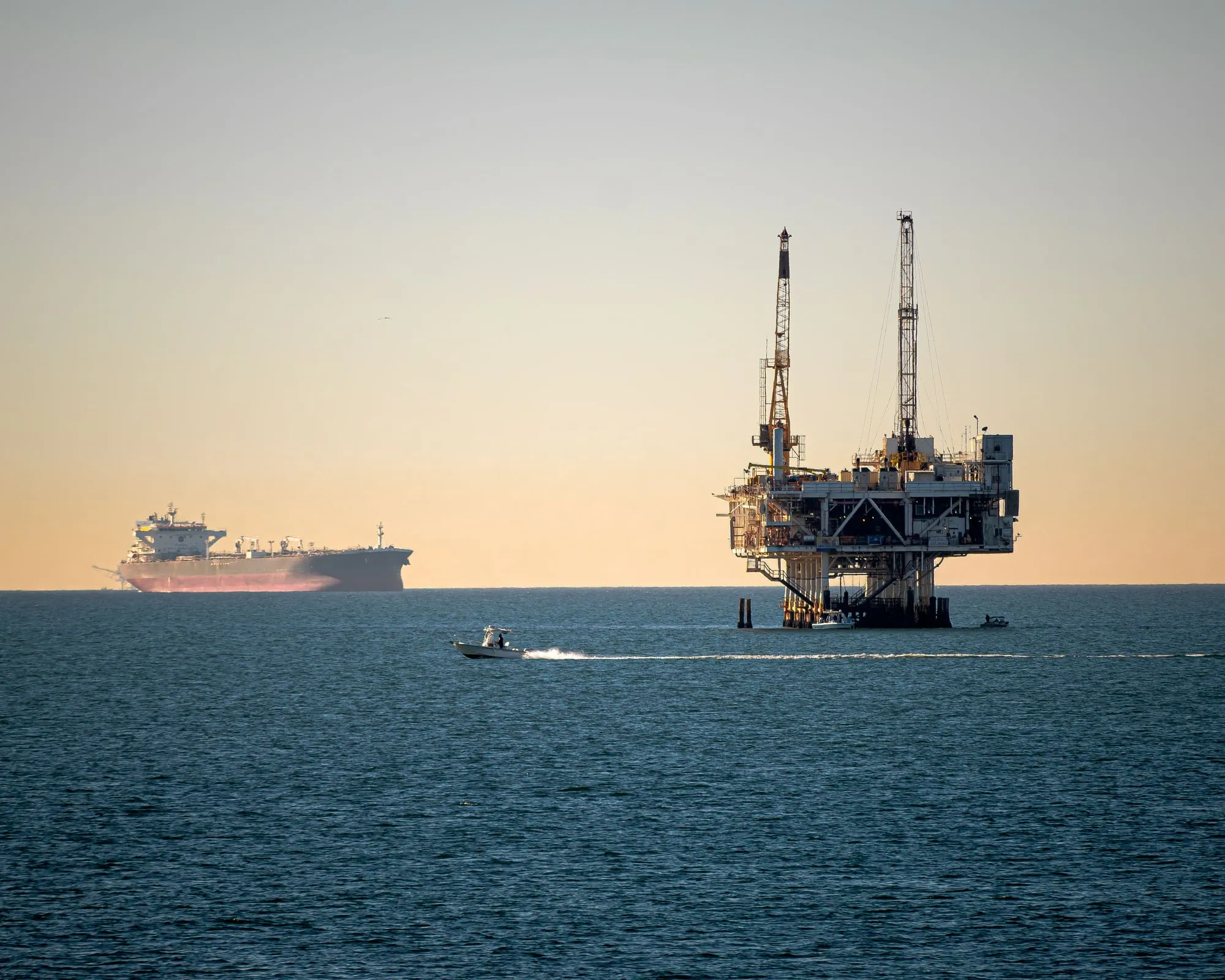
Offshore means the installation and the operation that serves it
We review serious injuries on and around the structures that produce oil and gas offshore and the operations that keep them running: fixed production platforms, jack-up and floating drilling rigs, drillships, floating production facilities, and the supply vessels, crew boats, liftboats, and helicopters that move people and equipment between them and the shore. That includes work in Texas state waters and on the federal outer continental shelf.
It does not address an onshore wellsite, pad, tank battery, or yard, however closely tied to offshore production; those are oilfield accidents. Harbor, terminal, and ship-channel operations are maritime accidents. The shore bases and fabrication yards that serve offshore work are land-based or harbor matters depending on the facts, not offshore ones.
Five facts decide which framework applies
Offshore, the legal framework is not attached to the injury. It follows from five facts, and the firm establishes each of them from records before it names a statute.
- Where the incident happened. Inside Texas state waters or beyond them on the outer continental shelf.
- What the structure was. A fixed platform attached to the seabed, a mobile unit that floats or jacks up, a floating facility moored in place, or a vessel in transit.
- How the worker was connected to a vessel. Whether the worker’s duties and assignments make the worker a member of a vessel’s crew, the question at the center of every Jones Act claim.
- Who the employer was. The operator, a drilling contractor, a service company, a staffing company, or a vessel operator, and what their contracts say.
- What the job was. Drilling, production, maintenance, catering, crane operations, diving, or transit, and what records that work generated.
Those five facts guide the investigation.
Federal waters, state waters, and the law that follows
Texas’s boundary runs three marine leagues, about ten statute miles, from its coast. Beyond that line the seabed is the federal outer continental shelf, and a federal statute, the Outer Continental Shelf Lands Act, extends federal law and jurisdiction to the seabed and to the artificial islands, installations, and devices attached to it for exploring, developing, or producing resources. For fixed structures on the shelf, that statute borrows the law of the adjacent state, Texas off the Texas coast, and applies it as federal law where it is not inconsistent with federal law.
The same statute extends the Longshore and Harbor Workers’ Compensation Act to injuries resulting from resource operations on the shelf, for workers who are not masters or members of a vessel’s crew. The Supreme Court has held that this extension can reach an injury with a substantial connection to shelf operations even if the injury itself occurred onshore.
Inside state waters the picture differs. The Supreme Court has held that work on a fixed platform in state waters is not maritime employment under the Longshore Act’s own terms, so a platform worker hurt inside the Texas line can face the Texas workers’ compensation coverage questions: whether the employer carried coverage, and what changes if it did not. None of this is decided from how far out the platform looked. The lease block and the operator’s report identify the location.
Fixed platforms, rigs that float or jack up, and the vessels between
Federal regulations describe three kinds of offshore structure. A fixed facility is bottom-founded and permanently attached to the seabed: production platforms, guyed towers, and similar structures. A floating facility is buoyant and moored so that it cannot be moved without special effort, such as a tension-leg platform or a permanently moored semisubmersible. A mobile offshore drilling unit is a vessel capable of drilling: jack-ups, semisubmersibles, and drillships.
The Supreme Court has treated fixed platforms as artificial islands rather than vessels, which is why compensation for their workers usually runs through the Longshore extension and why the adjacent state’s law is borrowed. Courts have treated mobile drilling units as vessels, which raises two further questions: whether a worker aboard is a crew member with Jones Act remedies, and whether a worker who is not a crew member may bring a negligence claim against the vessel under the Longshore Act. A jack-up rig with its legs on the seabed can be both a vessel and an offshore installation at the same time, and courts have analyzed rig hands in both frames.
Transit is part of the operation. A crew boat transfer, a personnel basket lift, and a helicopter flight each involve a company that is often none of the operator, the drilling contractor, or the worker’s employer, and each generates its own records.
Operator, drilling contractor, and service companies offshore
An offshore lease has an operator—the person or company designated to control or manage operations. Under the federal definition, the operator may be a lessee, a designated agent, or a holder of operating rights, so the leaseholder and operator are not necessarily the same company. The rig itself usually belongs to a drilling contractor, whose crew operates it under contract to the operator. Production, wireline, casing, cementing, remotely operated vehicle, catering, painting, scaffolding, crane, and diving companies work on location under master service agreements and bridging documents that assign scopes of work, safety-management responsibilities, and indemnity among the companies. Vessel and aircraft operators serve the whole arrangement under their own contracts.
Holding the lease does not make the operator answerable for every company on the facility, and the company that employs the injured worker is rarely the only one whose decisions bear on the event. Working from the persons-on-board manifest and the contracts, the firm lists every company that had people or equipment on the facility and obtains the master service agreements and bridging documents that set out what each one controlled. On the outer continental shelf, the Longshore Act preserves reciprocal indemnity agreements between employers and vessels, which is one reason the contracts are requested early rather than inferred.
BSEE, the Coast Guard, and what they record
The Bureau of Safety and Environmental Enforcement regulates offshore energy operations on the outer continental shelf. Its rules require the operator to report defined incidents to the district manager immediately by telephone and in writing within 15 days: all fatalities, all injuries requiring evacuation of the injured person to shore or another facility, losses of well control, fires and explosions, reportable hydrogen sulfide releases, collisions above a stated damage threshold, structural damage, crane and personnel-handling incidents, and damage to safety systems. Injuries that cause days away from work or restricted work are reported in writing within the same period. The written report identifies the operator, any contractor involved, the lease and block, the facility, and the operation underway at the time.
The bureau investigates deaths, serious injuries, fires, and pollution events, convenes panels for the most serious, publishes its reports, and coordinates with the Coast Guard to decide which agency leads a particular investigation. It also publishes offshore incident statistics, with its own caveats about how the numbers change as investigations close.
The Coast Guard’s role changed in 2026. Under a rule effective in 2026, the owner or operator of a fixed facility must notify the Coast Guard as soon as possible of a death and of listed serious casualties, and must follow with a written report. Floating facilities and mobile drilling units report under the Coast Guard’s vessel casualty rules. None of these agencies decides a civil claim, and how any agency finding may be used in a case is a legal question counsel addresses.
Offshore records and who keeps them
- The operator: the incident report to the bureau, the safety and environmental management system documents (job safety analyses, permits to work, stop-work authority records, simultaneous-operations plans), bridging documents with contractors, persons-on-board manifests, muster records, and medevac paperwork.
- The drilling contractor: daily drilling reports in the industry’s standard format, rig logs, jacking or mooring logs that show how the unit sat on the seabed, the unit’s inspection and class records, and the casualty report it files with the Coast Guard.
- The fixed-facility owner or operator: its Coast Guard notices and written reports, platform maintenance and inspection files, and crane inspection and certification records.
- The worker’s employer: payroll and hitch schedules, assignments to platforms versus vessels, training and competency records, and its master service agreements.
- Vessel and helicopter operators: logs, tracking data, passenger and crew manifests, and personnel-transfer procedures and incident reports.
- The agencies: the bureau’s investigation and panel reports, and the Coast Guard’s summary incident data, both public; how the Coast Guard’s own investigation reports may be used in a civil case is a legal question counsel addresses.
Facilities are remote, crews rotate, and electronic data is retained for varying periods on company systems. Preservation requests go to each company for the categories it controls.
Where crew status, harbor work, wellsite, and death questions are answered
- Whether a rig hand, engineer, or supply-boat deckhand is a seaman, and what negligence, unseaworthiness, and maintenance and cure mean, are Jones Act questions.
- The Longshore benefit system, its exclusivity, and a covered worker’s claim against a negligent vessel are the subject of Longshore and harbor worker claims.
- Onshore wellsites are oilfield accidents; harbor and terminal operations are maritime accidents.
- A fire, explosion, or gas release on a facility is taken apart for its mechanism as an explosion or a chemical exposure; the installation, the operation, and the companies also require investigation.
- A death offshore brings in the family and estate questions, and the specialized federal death statutes, of a wrongful death claim.
Bringing an offshore incident to the firm
The same five facts organize the first conversation: the facility’s name and its lease block, the operator, the worker’s employer, the other companies on location, whether the worker was evacuated and by whom, and any paperwork received since. Leatherwood & Schindler reviews offshore incidents from its one Houston office; the operators, drilling contractors, and service companies involved often make their decisions and keep their records in Houston as well. A consultation begins with the five facts described above, and the firm identifies which of them the records already answer and which still need to be established.