

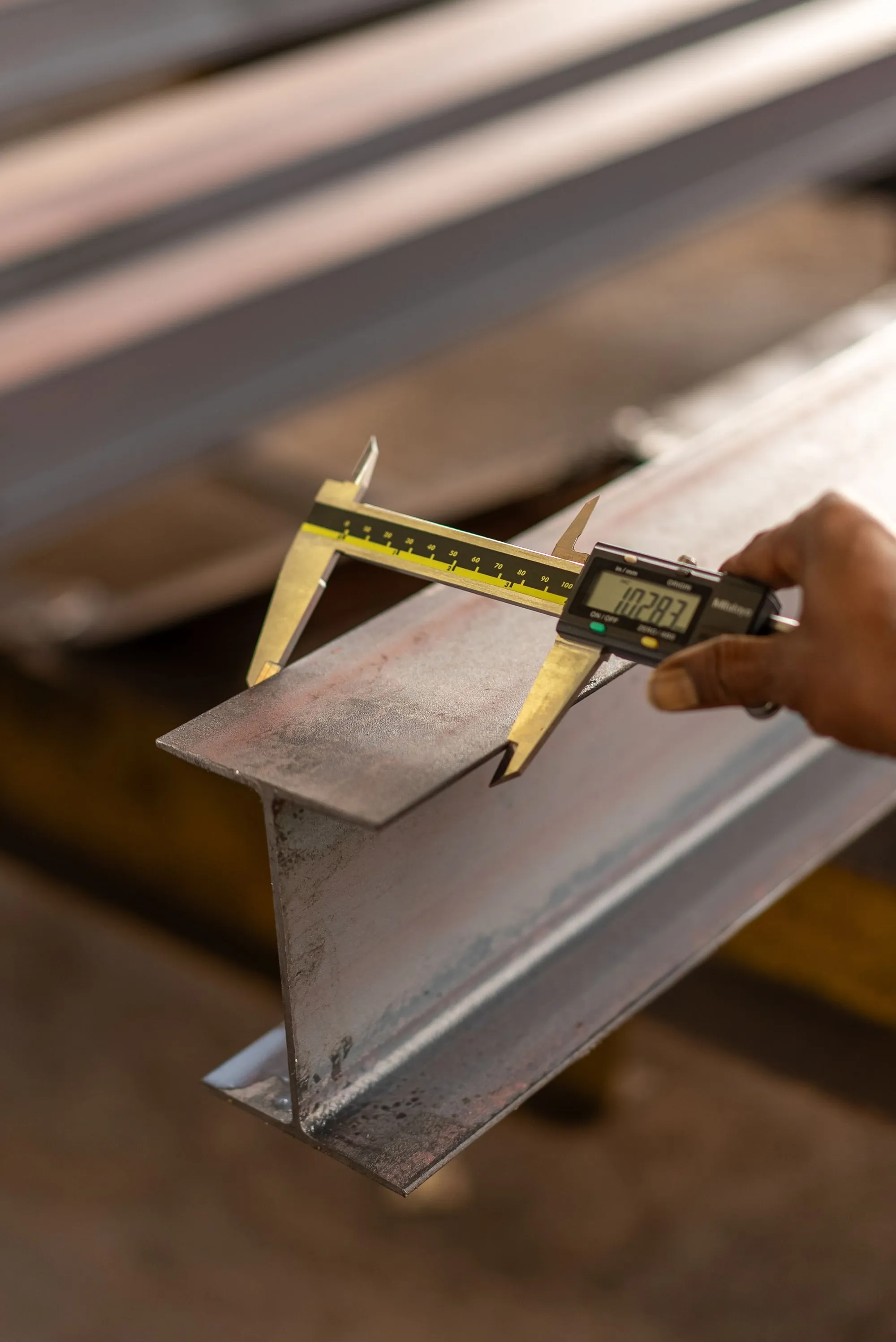
One unit, not the whole line
A manufacturing defect is a departure. The maker had a plan for the product, written as specifications, drawings, formulas, tolerances, and quality checks, and the unit that caused the injury did not match it. A weld that was never completed on one ladder, a tire from one production run missing a layer that every other run had, a bolt torqued below specification on one assembly, a batch of a food or drink product containing an ingredient that was not part of the recipe: each is an example of a unit that left the factory different from what was intended. These are illustrations, not descriptions of any client’s case, and none is a conclusion about any product.
That is a different question from whether the design was safe. If every unit built to plan carries the same danger, the question is a design defect question. If the unit was built as designed and the danger lay in what buyers were and were not told, the question is one of failure to warn. The three questions can arise together for one product, and a review does not choose among them from the injury alone. It starts from the unit.
What has to be shown
Texas law does not require a person injured by a manufacturing defect to prove that the maker was careless. It does require proof of three things: that the unit departed, in its construction or quality, from the maker’s specifications or planned output; that the departure made the product unreasonably dangerous; and that the departure was a producing cause of the injury, meaning a substantial factor without which the injury would not have happened.
The first of those is where a claim is tested. That a product broke, caught fire, or failed while it was being used is the reason to ask the question, but it is not the answer. The Supreme Court of Texas has held that evidence that a product malfunctioned does not, by itself, establish that a manufacturing defect existed when the product left the maker, and a claim that cannot identify the specific departure does not go forward. Identifying it takes the unit, the maker’s own records of what it was supposed to be, and technical examination by qualified engineers or other analysts, along with an honest look at other explanations: age, wear, repair, modification, and use.
How the product was used is part of that review, because Texas compares the responsibility of everyone involved, and a use the maker could not reasonably have anticipated is a different matter from an ordinary use that went wrong. None of this changes what the claim is about. It is about the unit.
Recalls, reports, and lawsuits are different things
A recall is a corrective action a company carries out, on its own or under an agency’s supervision, and the federal agencies that oversee consumer products and motor vehicles describe a recall by the hazard, the units involved, and the remedy offered, whether repair, replacement, or refund. A report to an agency is something else again: federal law requires manufacturers, distributors, and retailers to inform the Consumer Product Safety Commission when they learn of a defect that could create a substantial product hazard, and the Commission’s own guidance says a report does not by itself mean the Commission will conclude that a hazard exists. Federal rules even allow a company to report a problem and carry out a recall without admitting that a defect exists. Consumer complaints in the Commission’s public database are posted with the Commission’s statement that it does not guarantee their accuracy.
A civil claim asks a narrower question than any of those: whether this unit departed from its specifications and whether that departure caused this injury. A recall that covers the unit is a lead worth following, because the recall notice describes a hazard and the affected production dates or lot numbers, and the maker’s written notice of a defect to buyers can be evidence against it. It is not proof that the unit had the defect described or that the defect caused the injury. The absence of a recall is not evidence that the unit was built correctly, and a recall lookup can miss recalls that were already repaired, older recalls, and campaigns by small manufacturers. Whether a recall was issued, whether a report was made, whether an agency investigated, and whether a court would find a defect are four separate questions, and a review keeps them separate.
Who can be responsible
Texas law defines a manufacturer broadly: anyone who designs, formulates, constructs, rebuilds, fabricates, produces, compounds, processes, or assembles a product or any component part of it and places it into the stream of commerce. The company whose name is on the box is not always the only one in that description. The maker of a component that failed, the company that assembled the finished product, and a retailer that had a hand in designing or specifying a product it sells under its own brand can all fall within it, depending on what each actually did; putting a store’s name on the box does not by itself make the store the manufacturer.
A company that only sold the product stands in a different position. Texas law generally does not hold a seller that did not manufacture the product responsible for a manufacturing defect, but it lists specific situations in which a seller can be, including when the seller altered the product in a way that caused the harm, made an incorrect factual claim about the product that the buyer relied on, actually knew of the defect when it sold the product, or when the manufacturer is insolvent or beyond the reach of a Texas court. Which of those applies is a question of fact about the particular seller, not a rule that every store is responsible or that no store ever is.
Compliance with federal quality-control requirements does not settle a manufacturing-defect claim. Texas gives a product that met mandatory federal design or labeling standards a rebuttable presumption in the maker’s favor, and the statute states that the presumption does not extend to manufacturing flaws. The question remains whether this unit met the maker’s own specifications.
Safety first, then the unit and its identity
A product that failed may still be dangerous. If there is a smell of gas, smoke, a hissing or swelling battery, or a chemical release, everyone leaves first and calls 911 or the utility from outside; nothing else matters until that is done. A damaged lithium battery, an appliance that overheated, a gas connector or regulator, a pressure vessel, a tool that is still energized, a container of a chemical, a firearm: none of these should be handled, recharged, plugged back in, dismantled, tested, transported, or stored at home to see what went wrong or to keep it as evidence.
The Department of Transportation warns that damaged, defective, or recalled lithium batteries are more likely than undamaged ones to short circuit, release heat, or catch fire. The recycling drop-offs that stores and cities offer are for intact, worn-out batteries; a battery that has failed, swelled, or been in a fire is handled only as the fire department, the maker’s recall instructions, or a hazardous-waste program directs. Fire departments, utilities, hazardous-materials responders, and the recall instructions of the maker exist for this reason. The first job is that no one is hurt again; the evidence comes after, and qualified people arrange for the item to be secured, stored, and examined.
What can be done safely is to record where the item is and who has it. A repair shop, an insurer, a landlord, an employer, a fire marshal, or the maker itself may already hold it, and Leatherwood & Schindler asks qualified custodians to coordinate preservation and an examination where safely possible, without delaying protective action or an applicable recall remedy. Safety and recall instructions do not depend on permission from the firm.
Identifying information matters as much as the object: the model, serial number, lot or date code, and purchase date appear on paperwork, on the packaging, in a photograph of the label, in an online order history, or on the product registration, and they tie the unit to a production run and to any recall. The purchase date matters for another reason: Texas limits how long after a product was first sold a claim about it can be brought, separately from the time that runs from the injury, so an older product raises a question the firm has to review early.
Photographs already taken, the receipt, the box and manuals if they were kept, any messages with the seller or maker, and the names of everyone who saw the failure help build the account. A correctly built example of the same model, called an exemplar, is obtained later for comparison. Texas courts can penalize a party that destroys or loses evidence it had a duty to keep, which is another reason qualified custodians document its condition and custody while following safety and recall instructions.
Where a manufacturing question arises
A manufacturing question comes up inside other kinds of cases. Equipment that failed on a worksite is reviewed alongside a third-party workplace claim or a construction accident, where manufacturers, rental companies, and maintenance contractors are separated from an employer. A failure of a boat’s steering, throttle, fuel, or cutoff system arises in a boating or jet ski incident. An appliance, regulator, or connector that failed before a fire or explosion is a product question, and a collision itself is investigated as a car accident or a truck accident, while whether a vehicle component failed in or after it is the question that stays here. When the failure was fatal, a wrongful death claim determines who may act for the family and the estate. Burns and amputations are documented for their medical record and consequences; the product question stays here.
Houston is a manufacturing and distribution center, with a regional economy its business organizations describe as spanning fabricated metal, machinery, and chemical production, and a port complex through which consumer and industrial goods move. The makers, importers, assemblers, and sellers of a product that failed here are identified from the product and its paperwork, not assumed from where it was bought.
The first conversation
A first conversation with Leatherwood & Schindler about a product starts with what happened, where the item is now and who has it, what identifying information and paperwork exist, and the medical care so far. The firm then asks qualified custodians to preserve it where safely possible without delaying protective action or an applicable recall remedy, identifies the companies in the chain from design to sale, and determines what records to request and what examination is needed before the manufacturing question can be answered. A consultation begins with those facts; following safety and recall instructions takes priority over keeping the unit unchanged.