

The fall is proved from the surface
A slip-and-fall claim is about a specific condition at a specific time and place: rain tracked in at an entrance, a spilled drink in an aisle, a leaking cooler or roof, wax or polish on a tile floor, grease near a restaurant kitchen, produce on a supermarket floor, a mat that slid or curled, or a step down at a threshold that was not marked. Houston’s rain and humidity make entrances, breezeways, and parking-garage ramps places where water arrives on the floor without anyone spilling it, and the question is the same: what was on the surface, and what did the business do about it.
The condition is the subject of the claim, so the review begins by identifying it as precisely as the record allows. A fall on a broken stair, a failed railing, or heaved pavement is reviewed as a condition of the property, under the framework that both reviews share.
How long the condition existed
Texas asks whether the business knew about the condition or whether it existed long enough that a business exercising reasonable care would have found it. Texas courts have refused to attach a stopwatch to that second test; no fixed number of minutes or hours decides it. They weigh three things together: the time the condition existed, how near employees were to it, and how visible it was. A spill next to a staffed register and a spill in an aisle no employee passed for the afternoon are judged differently, and no single fact decides the question.
The evidence for time is indirect. Video can show when a substance appeared and who walked past it. A sweep or inspection log can show when the area was last checked. The condition of the substance, whether it had dried at the edges, been tracked through by carts and shoes, or collected dirt, can suggest duration, although courts have held that footprints and tracks alone, without evidence of how long they took to form, do not prove it. Texas courts require this proof even when little evidence exists, which is why the firm requests the records before they are replaced.
What the business knew versus what it should have found
Knowledge can be actual: an employee spilled the liquid, another customer reported it, or a manager knew the cooler leaked and a puddle was there when the store opened. It can be constructive, in the sense described above. Either way, it has to be knowledge of the condition at the time and place of the fall. A store’s general awareness that its entrance gets wet when it rains is not the same as knowledge of the puddle a person slipped in.
A business’s own inspection schedule is evidence, not a legal standard. Missing a scheduled sweep does not by itself prove the business knew of a hazard, and completing one does not by itself prove it could not have known. What the schedule was, whether it was followed, and what the employee who followed it saw are facts the log and the employee’s statement supply.
Warning signs and cones
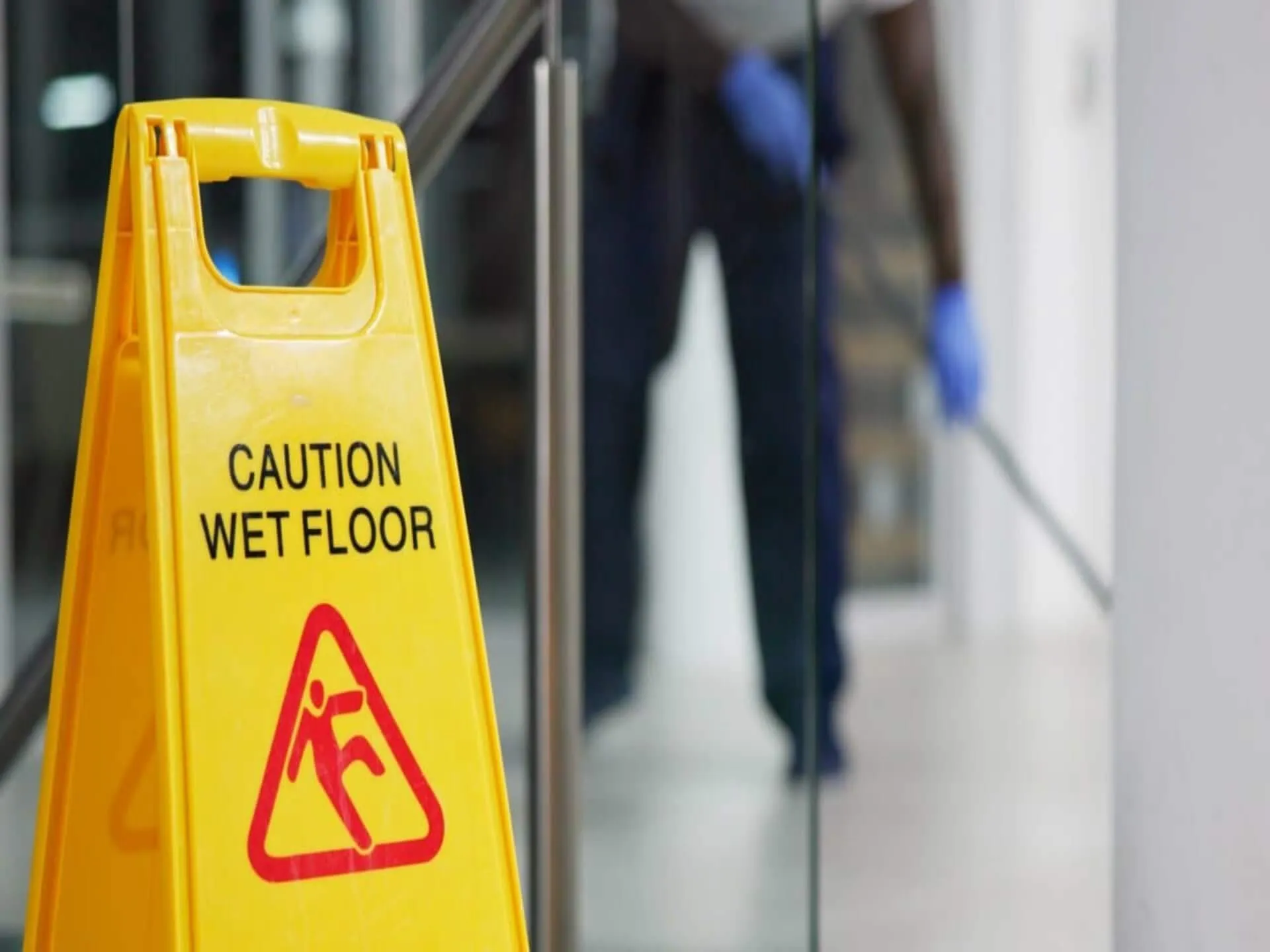
A business can meet its duty by fixing a dangerous condition or by adequately warning of it, and a wet-floor sign placed at the hazard before the fall can be enough. The questions are where the sign was relative to the spill, when it was put there, and whether it addressed the danger that caused the fall. A permanent sign at the front door does not warn of a spill in the back aisle. A sign placed after the fall did not warn the person who fell. Texas courts have recognized that in some situations a warning cannot substitute for fixing the condition. A warning is neither an automatic defense when present nor automatic responsibility when absent.
Who was responsible for the floor
The business whose floor it was is the first place to look, and not always the only one. In a shopping center, the lease decides whether the landlord kept the parking lot, sidewalks, and other common areas while each tenant answers for its own space. A janitorial contractor may be responsible for the cleaning it agreed to perform on a schedule, and a mat-service vendor for the mats it placed. In an apartment community, the owner and its management company are responsible for breezeways, stairs, and pool decks, while the interior of a unit raises different questions. The lease and the service contracts show the division, and the firm identifies each responsible party before it asks for records, because each holds its own.
The records that show what was on the floor and when
The property’s records: video from the cameras covering the area and the entrance, which the firm asks in writing to be preserved as soon as it is retained; the sweep or inspection log for that area and that day; the incident report the business prepared, including what it recorded as the substance on the floor; employee statements; maintenance and repair records for a leaking roof, cooler, or drain; and prior incident reports for the same area. The person who fell holds records too: photographs of the floor and the substance if any were taken, the shoes and clothing worn that day kept as they were, the names of witnesses and of the employees who responded, and the medical records that connect the fall to the injury, beginning with the emergency or urgent-care visit.
Texas compares the responsibility of everyone involved, including the injured person. What the person was carrying, wearing, and looking at will be asked about, and the same photographs and video that show the condition also show whether it could be seen. The firm addresses those questions from the record rather than from the business’s characterization of them.
Falls at work and serious injuries
A fall in the course of employment turns first on whether the employer carries Texas workers’ compensation coverage, and that workplace injury framework raises separate questions when other companies controlled the worksite. A fall that caused a head injury, whether or not the person lost consciousness, is also documented as a traumatic brain injury, and a fracture or other injury that changes what a person can do as a catastrophic injury. A fatal fall becomes a wrongful death claim.
What to do now
Ask the business for a copy of its incident report if one was made, keep the shoes and clothing unwashed, write down the names of witnesses and responding employees while they are fresh, photograph the area if you can return safely, and get the medical care the injury needs. Bring to a consultation where you fell, what was on the floor, and what has been said to you since.