

The review begins at the crossing
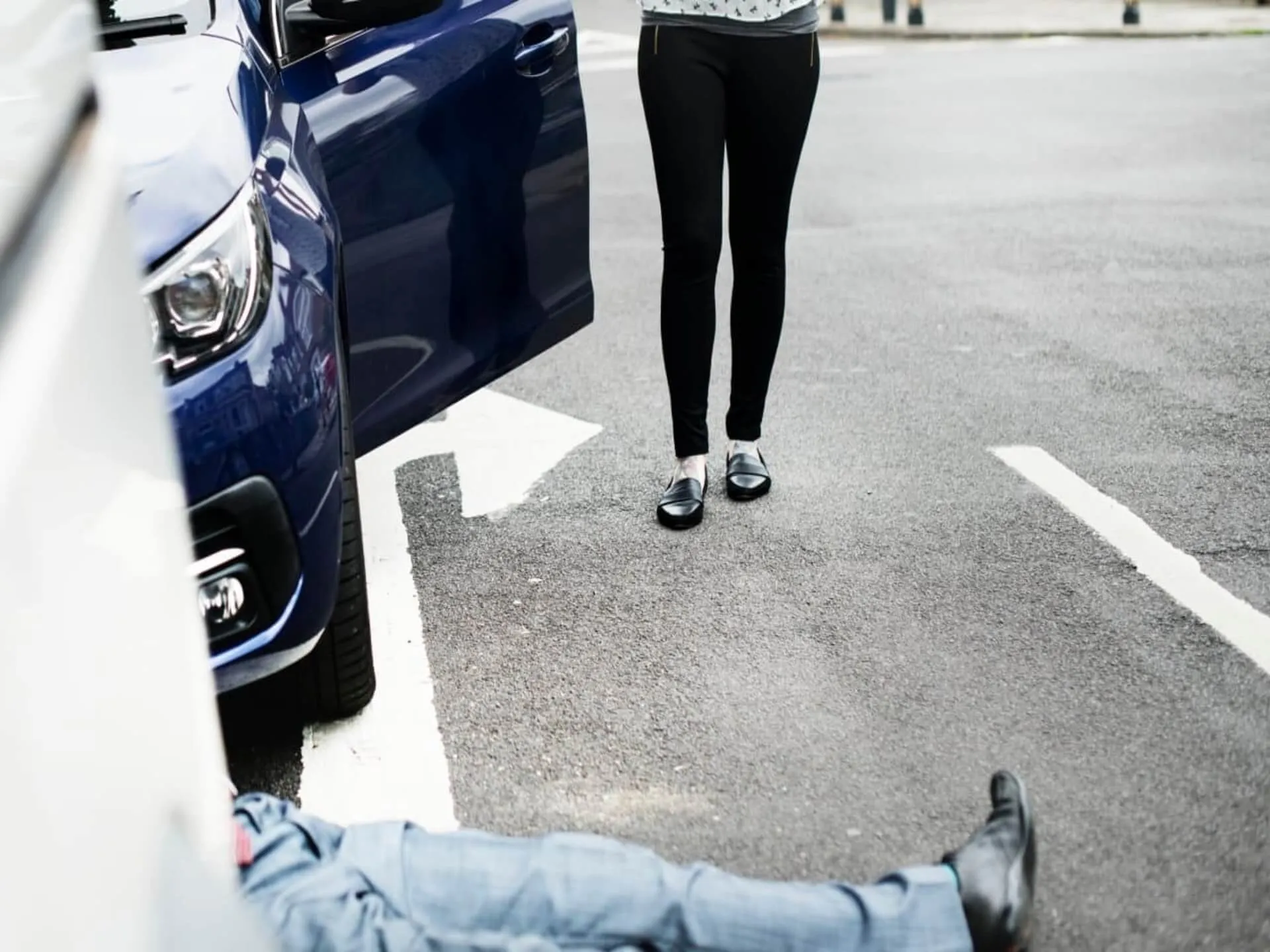
In a collision between a vehicle and a person on foot, the vehicle carries most of the physical evidence and the driver gives the first account. The person who was struck may be unable to describe what happened for days, and the crash report may be written before anyone has asked. That is why the firm begins a pedestrian review at the crossing itself: where the person was, what the traffic signal or the crosswalk required of the driver and of the pedestrian at that moment, and what the vehicle, the roadway, the cameras, and the witnesses show about the seconds before contact.
Texas defines a pedestrian as a person on foot, and it treats a person using a wheelchair or a motorized mobility device as a pedestrian. The Texas crash report gives the pedestrian a unit entry of its own, with the light condition and the traffic control at the location. Texas weighs each party’s conduct against the other’s, as in any Houston car accident, and where the person on foot stood is one fact in that weighing rather than the end of it.
Marked crosswalks, unmarked crosswalks, and the rules at each
A crosswalk under Texas law is either a portion of the roadway marked as a pedestrian crossing or the unmarked portion of the roadway at an intersection that lies between the extensions of the sidewalk lines on each side. An unmarked crosswalk exists at an intersection whether or not anything is painted there, which is why the review measures the intersection rather than relying on the paint.
Where no traffic signal is in place or operating, a driver must stop and yield to a pedestrian crossing in a crosswalk who is on the driver’s half of the roadway or approaching so closely from the other half as to be in danger, and a driver coming up behind a vehicle that has stopped at a crosswalk to let someone cross may not pass it. The pedestrian’s side of the rule is that a person may not suddenly leave a curb or other place of safety and step into a crosswalk in the path of a vehicle so close that the driver cannot stop and yield.
Outside a crosswalk, the duties shift. A pedestrian crossing a roadway somewhere other than a marked crosswalk or an unmarked crosswalk at an intersection must yield to vehicles, and between two adjacent signalized intersections a pedestrian may cross only in a marked crosswalk.
None of that ends the driver’s obligations. Notwithstanding any other provision of the pedestrian chapter, a driver must exercise due care to avoid colliding with a pedestrian on the roadway, must sound the horn when necessary, and must take proper precaution on seeing a child or an obviously confused or incapacitated person. A person struck outside a crosswalk is not automatically responsible, and a person struck inside one does not automatically win. The evidence about speed, attention, lighting, and sight lines decides what those rules mean in a particular case.
Signals and turning vehicles
At a signalized crossing, a pedestrian facing a Walk signal may cross in the direction of the signal, and the driver must stop and yield. A pedestrian may not start across against a Don’t Walk or Wait signal, and one who is partway across when the signal changes must continue to the sidewalk or a safety island. A driver facing a circular green signal, a green arrow, or a red signal before a permitted turn must stop and yield to pedestrians lawfully in the intersection or in an adjacent crosswalk before turning. The general left-turn statute, which requires a driver to yield to oncoming vehicles, governs vehicles rather than pedestrians; the pedestrian’s protection at a turn comes from the signal rules and the due-care rule.
Those stop-and-yield duties were strengthened in 2021 by legislation known as the Lisa Torry Smith Act, which also created a separate criminal offense for a driver whose criminal negligence in a crosswalk injures a pedestrian or a person on a bicycle, a motor-assisted scooter, or certain other small vehicles the statute lists. A criminal case, when one is brought, proceeds on its own track and produces records the civil review can use. This page does not describe the offense or its penalties, and a civil claim does not depend on one.
Signal timing is a record. Houston Public Works operates and periodically retimes the City’s signalized intersections, and its timing records can show how long the Walk phase lasted, whether the crossing had a pedestrian-only phase or a leading interval, and when the timing last changed. The City’s Vision Zero Action Plan names pedestrian signal phasing among its design priorities, which is context for what a crossing was designed to do, not evidence of what happened at it.
Parking lots, driveways, and private property
A driver emerging from or entering an alley, building, private road, or driveway must stop before crossing the sidewalk and yield to a pedestrian approaching on it, and a driver emerging from an alley, driveway, or building in a business or residence district must stop before the sidewalk area and yield to any pedestrian or sidewalk user. A person struck on a sidewalk by a vehicle backing out of a driveway or pulling out of a store’s exit has a statute written for that situation on the driver’s side of the ledger, and the crash report carries a contributing-factor code for a driver who failed to yield from a private drive.
Inside a parking lot the record changes. TxDOT’s crash-report instructions state that there is no statutory requirement to report a crash that occurred entirely within a private residential parking area or within a private lot that charges a fee for parking, so a pedestrian struck in one of those places may have no state-filed crash report, and the investigating agency’s own file, the business’s incident report, and the property’s cameras become the record. The rules of the road are written for public roadways, and which of them reached a private lot, along with what the property owner controlled about its layout, lighting, and traffic pattern, is a legal question counsel evaluates rather than a rule the page can state.
Transit stops, school zones, and the vehicles that serve them
A person struck at or near a bus stop stands where the sidewalk, the shelter, the curb cut, and the bus’s own movements meet. The Metropolitan Transit Authority of Harris County describes most of its stops as built with bus pads, sidewalk links, and curb cuts, which is part of the crossing’s design record. Which records METRO keeps about a bus, its route, and its cameras, how they are requested from a public authority, and what changes when the vehicle was a school bus, a charter, or an intercity coach are questions of the bus accident review. We also investigate the crossing and the person who was struck.
School zones add a school crossing guard, whom Texas defines and authorizes to direct traffic, along with signal and speed-zone records that the City or the school district holds. A collision in a school zone can involve a public entity in more than one way, and those questions are gathered with the bus and school-bus operator questions.
Lighting, sight lines, and roadway design
The Texas crash report records the light condition for every crash, from daylight to dark with or without lighting, and Texas requires a vehicle to display its headlamps at night and whenever light is insufficient for a person on the roadway to be clearly discernible at a distance. Whether the headlamps were on, whether they were aimed and working, and whether the streetlights at the location were lit are records, not impressions. CenterPoint Energy maintains many of the streetlights on Houston’s streets and identifies most poles by a number, and its outage and repair records can show whether a light was working on the night in question.
Sight lines are documented the same way: parked vehicles, vegetation, signal placement, the crest of a hill or the curve of a frontage road, and the width of the crossing. Houston Public Works’ sidewalk programs build and repair sidewalks along thoroughfares and routes to schools and bus stops, and the Texas Department of Transportation maintains a statewide pedestrian safety action plan that analyzes where pedestrian crashes occur and how roadway design responds. Those programs are context for what a location was designed to be. Whether a public entity’s design or maintenance of a roadway is part of a particular claim is a separate question that counsel evaluates, and a claim against a public entity carries notice rules of its own.
Safety campaigns ask pedestrians to wear reflective clothing and carry a light at night. That is advice for the future. It is not a rule that assigns responsibility for a collision that has already happened, and what a person was wearing is not a finding of fault.
Evidence when the person had no vehicle
A person on foot leaves no skid marks and carries no event data recorder, so the vehicle and the scene carry the physical record. The location and height of the damage on the vehicle, which the crash report codes against a standard damage guide, show where the contact occurred. The vehicle’s own recorded data, if the vehicle stored any, may show its speed, braking, throttle, and restraint use in the seconds before impact. Established reconstruction methods use the vehicle’s deformation, the marks on the roadway, and the distance the person was carried or thrown to estimate the vehicle’s speed, and the firm retains that analysis when the speed is disputed. No figure from any of those methods is stated here.
The person’s own belongings are evidence as well. Clothing, footwear, a phone, and anything carried should be kept as they are, because they record contact and position. Witnesses matter more than in a collision between two vehicles, since the person struck may not have seen the vehicle coming, and the cameras that faced the crossing are sought at once, because many systems keep footage only briefly. When a pedestrian collision inside the City of Houston is fatal, the Houston Police Department’s Vehicular Crimes Division, which includes a crash reconstruction unit, investigates, and its file becomes part of the record once the law allows it to be released.
Trucks, company vehicles, buses, and drivers who left
The kind of vehicle that struck the person decides where the rest of the investigation goes. A commercial truck adds the carrier’s records. A company vehicle brings the employer into the review. A bus brings in the operator and, often, a public entity. When the driver left, hit-and-run identification work proceeds alongside review of other potentially responsible parties and coverage.
Who counts as a pedestrian, and the pages for everyone else
Alongside the pedestrian definition above, Texas has, since September 1, 2025, defined a sidewalk user as a person lawfully riding a bicycle, a motor-assisted scooter, a skateboard, roller skates, or a similar device on a sidewalk. A person on a bicycle is reviewed under bicycle accidents, which cover the sidewalk-user rules, and a person on a motor-assisted scooter under scooter accidents.
When a pedestrian is struck by a cyclist or a scooter rider rather than by a motor vehicle, we investigate the person’s position and conduct, and the device and, for a rental scooter, the company behind it are reviewed separately. A person on foot struck by a train at a crossing or along a track raises the rail rules of a train accident. When the person struck does not survive, a wrongful death claim determines who may act for the family and for the estate, and the crossing review described here supplies the event record.
Speaking with the firm after a pedestrian collision
Whatever the family has is a starting point for a consultation: the crash report number, the location and time, the names of anyone who stopped, photographs of the crossing and the vehicle, and the medical records to date. A family member can begin while the person who was struck is still in the hospital. Leatherwood & Schindler will identify the crossing’s rules, the vehicle’s records, the cameras that faced the location, and the public or private entities that hold the rest. Where the person was standing is a question the evidence answers, not the starting assumption.