

Who ran the train, who owns the track, and who maintains the crossing
A collision with a train involves organizations that a driver or a person on foot never sees. The railroad whose crew operated the train may not own the track. The entity responsible for maintaining the crossing’s warning devices may be the track owner, a lessee, or a contractor. The roadway that crosses the tracks belongs to a public road authority, which in the Houston area may be the Texas Department of Transportation, the City of Houston, Harris County, or a neighboring city. Each of those organizations holds a different part of the record, and the review begins by identifying all of them.
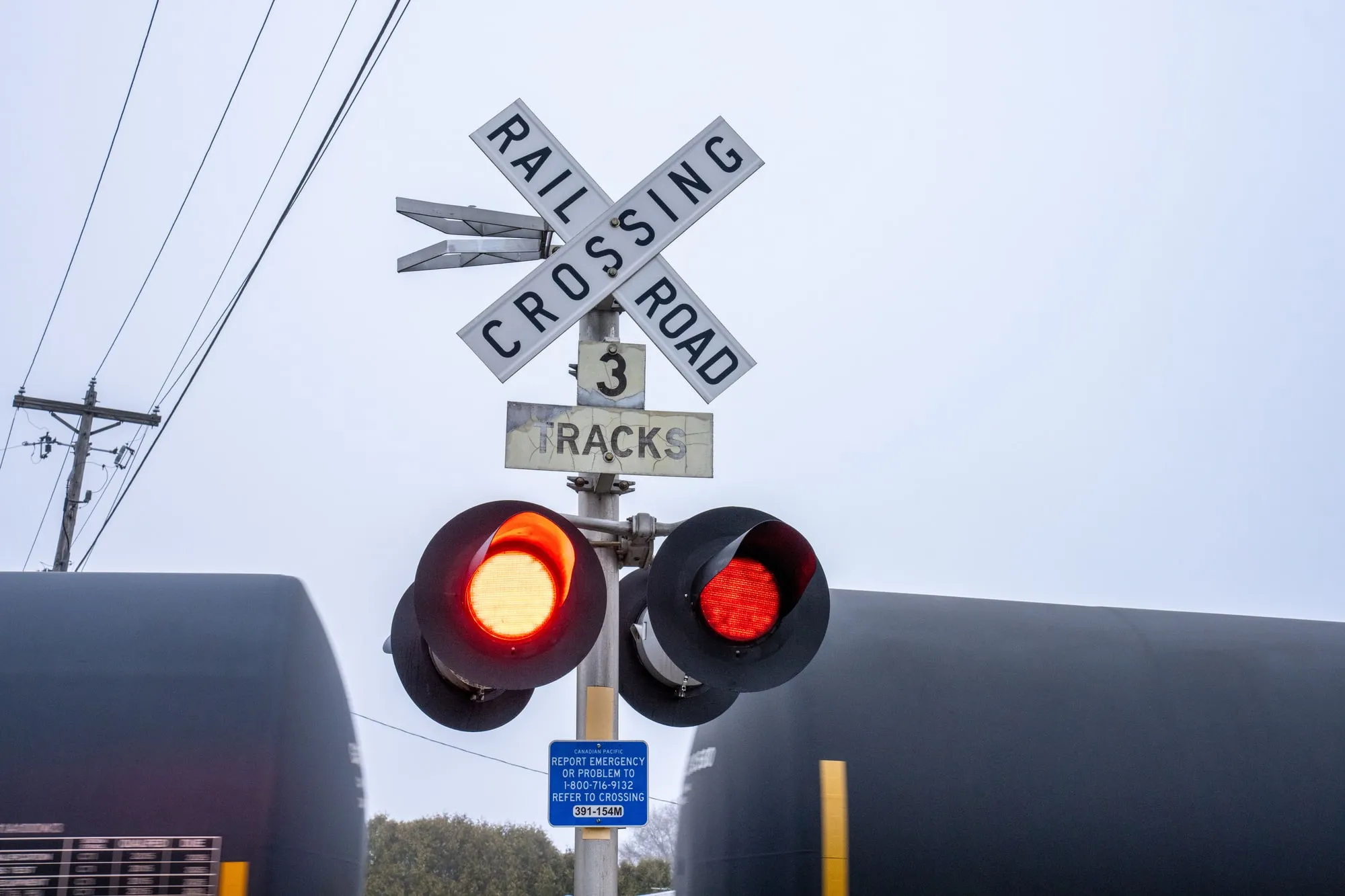
The crossing itself is the starting point. Every public highway-rail crossing has a number in the federal crossing inventory, and federal rules require that number to appear on the blue emergency notification sign posted at the crossing, together with a telephone number for reporting a problem. The inventory, which the railroads that use each crossing must keep current, records the warning devices installed, the tracks, the trains, and the responsible railroad, and it is publicly searchable. For the roadway side of a crossing collision, the crash report and the responding agency’s file come from the same sources as after any Houston car accident. The railroad’s records add to that evidence.
A railroad employee injured while working may have a claim under FELA, depending on the employment relationship, the railroad’s covered operations, and the applicable basis for liability. Those are railroad worker FELA claim questions; employment near a railroad does not by itself establish coverage or recovery.
Grade crossings: gates, lights, crossbucks, and what Texas requires of drivers
Not every crossing has gates or flashing lights. Some are protected by active warning devices that activate when a train approaches; others are marked only by the crossbuck sign, sometimes with a stop or yield sign, and the driver is expected to look.
Texas law requires a driver to stop within a set distance of the nearest rail when a signal warns of an approaching train, when a gate is lowered, when a flagger signals, when an approaching train sounds its horn and is an immediate hazard, when a train is plainly visible and close enough to be a hazard, or when a sign or signal otherwise requires a stop, and it prohibits driving around or under a gate that is closed or moving. At a crossing marked only by a crossbuck, the driver must yield to a train that is close enough to be a hazard and proceed at a speed reasonable for the conditions. Buses carrying passengers for hire, school buses, and vehicles carrying certain hazardous cargo have stop-or-slow, look, and listen rules of their own at crossings, with exceptions written into each.
Texas statutes place certain sign and maintenance duties on railway companies at some crossings, and federal rules govern the warning devices themselves; which duties applied at a particular crossing, and what any failure means for a claim, is a question counsel answers from the crossing’s history rather than from a general rule. A road authority controls the pavement markings, advance signs, and sight lines on the roadway approach. Whether the warning devices at a particular crossing were adequate, and whether a driver complied with the rules above, are separate questions answered from the crossing’s inventory record, its history, its sight lines, and the records described below. A driver’s violation is one fact in the record rather than the end of the inquiry, and the absence of a gate is not a finding against the railroad.
When a signal fails: what the railroad must record and do
Federal rules define two kinds of warning-system malfunction. An activation failure is the system’s failure to warn of an approaching train within the required time, or to indicate a train occupying the crossing. A false activation is the system warning when no train is coming, a condition that requires repair. When a railroad receives a credible report of either, it must notify its train crews and any other railroad using the crossing, notify law enforcement, and provide alternative warning at the crossing, by a flagger or officer, by reduced train speed, or by stopping each train and having a crew member flag traffic across, until the system is repaired. The railroad must keep a record of every credible malfunction report, its response, and the repair, and it must report certain activation failures to the Federal Railroad Administration.
The same rules require the responsible railroad to inspect and test the warning system on a schedule and to record the results, including the warning time the system actually provides. Federal track-safety rules separately require a railroad to control vegetation on its property so that it does not obstruct the view of signs and signals at crossings. Sight distance along the tracks is a design and maintenance question for the railroad and the road authority, and it is documented at the scene as it was on the day of the collision.
The event recorder, onboard cameras, dispatch, and the horn
A train operated above a set speed must have an event recorder in its lead locomotive, and depending on the recorder’s generation it captures speed, direction, time, throttle position, brake applications, and horn activation, among other data. When a locomotive is involved in an accident the railroad must report to the Federal Railroad Administration, the railroad must preserve the recorded data for analysis, keeping the original download in secure custody.
Passenger trains will be required to carry inward- and outward-facing image recorders on lead locomotives by a federal compliance date in 2027, with a preservation duty after a reportable accident; audio recording is not required by that rule, freight railroads are not required to carry cameras, and some have installed them voluntarily. Dispatch records and signal-system records show what the crew was told and what the signals displayed, and the railroad must keep the results of its signal inspections and tests.
Federal rules require a train to sound its horn within a set window before it reaches a public crossing, unless the crossing is within an established quiet zone, where horns are not routinely sounded and the crossings carry additional protection. The City of Houston has established a number of quiet zones and has requested more. Whether a crossing was in a quiet zone, and what the event recorder shows about the horn, are part of the record in any Houston crossing collision.
Reports to federal agencies, and what those reports can and cannot do
A railroad must report every collision between a train and a highway user at a crossing, whether a car, a truck, a bus, a motorcycle, a bicycle, or a pedestrian, to the Federal Railroad Administration on a monthly report regardless of the damage or injury, and it must report certain events, including a fatality at a crossing, immediately. Those reports are public through the agency’s records process, but federal law provides that the railroad’s monthly reports may not be used as evidence in a damages action. What that limit means for a particular claim is a question counsel evaluates.
The National Transportation Safety Board has authority to investigate rail accidents that involve a fatality, substantial property damage, or a passenger train, and it investigates some of them. Its investigations find facts and recommend safety improvements rather than deciding civil liability. Federal law restricts use of the Board’s accident report, including its probable-cause determination, in a civil damages action. Factual investigative materials are treated separately and may be usable, subject to evidence rules and counsel’s review.
The Texas Department of Transportation’s Rail Division administers the federal crossing-safety funding program in Texas, maintains the state’s database of public crossings, and publishes the state rail plan. The Railroad Commission of Texas, despite its name, regulates oil and gas rather than train operations and is not part of a rail collision review.
Federal law and the shape of a rail claim
Railroad safety is regulated largely by federal law, and Congress has made that regulation nationally uniform to the extent practicable. That uniformity can affect which state-law claims may proceed against a railroad, particularly where federal funds paid for the warning devices installed at a crossing. The same federal law expressly preserves a state-law claim that a railroad failed to comply with a federal standard of care, with its own plan or rule adopted under federal regulation, or with a compatible state law. Which of those rules governs a particular crossing, and what they mean for a particular collision, is a legal question turning on facts about the crossing’s history and funding, and the firm evaluates it with counsel rather than stating a general answer.
Freight, Amtrak, and METRORail are three different operations
Houston is served by Class I freight railroads, including Union Pacific and BNSF, by the Port Terminal Railroad Association that serves industry along the Houston Ship Channel, and by Amtrak, whose Sunset Limited stops in Houston. Freight and intercity passenger trains operate under Federal Railroad Administration rules, and a passenger’s ticket and the train’s manifest place the person on the train.
METRORail is different. Houston’s light-rail network is operated by the Metropolitan Transit Authority of Harris County and is overseen through the Texas Department of Transportation’s State Safety Oversight program for rail transit, under the Federal Transit Administration’s framework, rather than through the federal railroad rules above. The records a METRORail incident generates sit with the transit authority and the state oversight program, not in the federal railroad accident database, and the authority is a governmental unit subject to the same notice rules and legal limits that apply to a claim against METRO’s bus operations. A collision between a METRORail train and a car, a cyclist, or a person on foot along its street-running lines is reviewed under that framework.
Houston has several hundred at-grade crossings within the city, by the City’s own count, and the City, the county, the Texas Department of Transportation, and the railroads have funded grade-separation and crossing-consolidation projects on several corridors and are studying the regional freight network. That context explains why crossings matter here. It does not say that any crossing is safe or unsafe.
People on foot near the tracks, and passengers on the train
Texas law prohibits a pedestrian from moving in front of, under, between, or through the cars of a train occupying a crossing. What the crossing’s warning devices showed and sounded is part of the record for a person on foot as well, and how the crossing rules bear on a pedestrian is a question counsel evaluates. A person on railroad property away from a crossing raises a different legal question. Texas law treats a person who enters land without permission differently from a person who is there lawfully, with particular rules where a child is injured by a dangerous condition, and how those rules apply to a railroad’s right of way is decided by counsel from the facts rather than stated as a rule here. A train striking someone at a station or crossing raises railroad questions; a person on foot struck by a road vehicle has a pedestrian accident claim to review.
A passenger hurt aboard a train in a derailment, a collision, or a sudden stop has the operator’s passenger, crew, and operating records to draw on, and the National Transportation Safety Board investigates passenger-train accidents. A truck struck at a crossing brings in the carrier’s records, and a bus struck at a crossing brings in the operator framework.
Railroad workers, deaths, and where the review continues
A railroad employee injured while working may fall within FELA, subject to the employment, covered-operation, and liability questions described above, and railroad worker FELA claims are explained separately. The two share evidence, since the same event recorder, signal records, and crossing history matter to both, and they do not share a legal framework. A death at a crossing is among the events a railroad must report immediately, as noted above; a wrongful death claim then raises the family and estate questions.
Talking with the firm about a train collision
The location is the first thing to bring to a consultation: the crossing or station, the number on the blue sign if it was photographed, the railroad’s name if it was visible on the locomotive, the crash report number, and any form or letter received from a railroad since. Leatherwood & Schindler will identify the railroad, the track owner, the crossing’s maintainer, and the road authority, request the event recorder data and the signal and crossing records promptly, because those records are not kept indefinitely, and explain how federal and Texas law shape the claim. The record is requested first; conclusions come after it.