

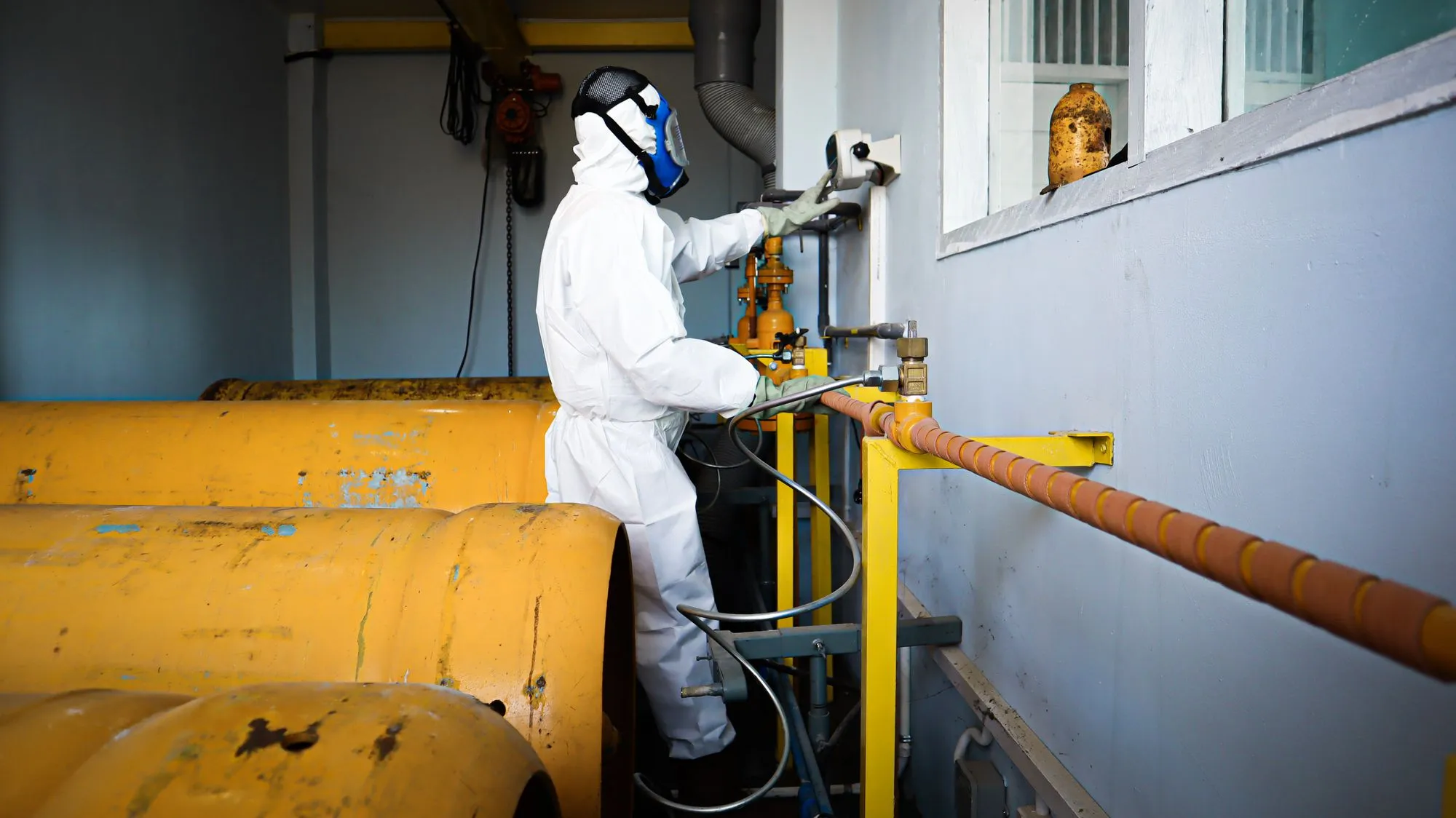
When people think of oilfield dangers, they often imagine fire or heavy equipment. But some of the most serious risks are invisible, like gas that can quickly overcome a worker, fumes inside a tank, or air with too little oxygen in a confined space.
If you or someone you love was exposed at a wellsite or other oilfield location, this article is about what to ask and what to protect. It is not medical advice. Your doctors guide your care.
Where these exposures happen, in general terms
OSHA identifies hydrogen sulfide, hazardous gases and vapors, and other chemical exposures as recognized hazards in oil and gas extraction. Exposure may occur during particular operations around tanks, fluid transfers, process equipment, or confined or poorly ventilated spaces. Some atmospheres can be oxygen-deficient, defined in applicable OSHA confined-space rules as less than 19.5 percent oxygen. Different substances have different exposure pathways and effects; a site-specific hazard assessment is necessary. [Sources: OSHA, Oil and Gas Extraction: Health Hazards; 29 C.F.R. §§ 1910.146(b), 1926.1202.]
Questions worth asking
- Was there a hazard assessment before the work? Who did it?
- Were gas monitors in use? Were they tested and working? Who carried them?
- Were alarms, wind indicators, and escape routes in place?
- Was there a rescue plan, and did people know it?
- Was training current? Was breathing equipment provided and in good shape?
- Were other companies’ crews or equipment nearby?
These questions do not assume anyone was careless. They are simply the starting point for a careful investigation.
Why exposures are hard to prove
An exposure may leave little visible evidence, and the substance, concentration, duration, and medical findings may be disputed. Monitoring logs, calibration records, work permits, witness accounts, and medical records can help reconstruct what happened. Different hazards have different medical effects: an acute oxygen-deficient atmosphere is not the same as a toxic-gas exposure or a slowly developing occupational disease. Medical professionals evaluate diagnosis and causation, while counsel investigates workplace duties and evidence. [Sources: OSHA, Oil and Gas Extraction: Health Hazards; OSHA confined-space standards.]
Workers’ comp and other companies
Workers’ compensation generally provides the exclusive remedy against a covered employer for a covered workplace injury, with statutory qualifications. Whether a property owner, operator, contractor, or other company might be liable depends on its duties, role, and available defenses, not merely its presence on the site. A lawyer should also assess which regulations apply to the particular work and whether the injury is accidental or an occupational disease. [Sources: Tex. Lab. Code § 408.001; Tex. Civ. Prac. & Rem. Code ch. 95, where applicable.]
What to do
- Seek medical care immediately and tell your providers what you were exposed to, where it happened, and for how long, as best as you can. Be sure to mention every symptom, even minor ones.
- Report the incident or suspected work-related disease promptly to your employer or supervisor, preferably in writing. Under Texas workers’ compensation law, the usual 30-day notice period runs from an accidental injury or, for occupational disease, from when the employee knew or should have known the condition may be related to work. Exceptions may apply. [Sources: Tex. Lab. Code §§ 409.001-.002.]
- Make a list of everyone who was present and note what the monitors, alarms, or crews did during the incident.
- Do not remove anything from the site. Request in writing that gas detection records, work permits, and training records are preserved.
- Keep a copy of every form and make sure to read each one before signing.
- Speak with a lawyer before you give any recorded statement.
Two clocks
For a covered Texas workers’ compensation claim, the usual one-year filing period runs from an accidental injury; for occupational disease, it generally runs from when the worker knew or should have known the disease was related to employment. Different triggers and statutory exceptions matter. A separate personal injury lawsuit usually has a two-year limitations period after accrual, but legal viability and deadlines depend on the defendants and claim type. Seek an individualized deadline assessment rather than waiting for symptoms or test results to resolve. [Sources: Tex. Lab. Code §§ 409.003-.004; Tex. Civ. Prac. & Rem. Code § 16.003.]
If a family member died
Texas allows certain family members to bring a wrongful death claim when a person dies because of another’s wrongful act, neglect, carelessness, unskillfulness, or default. [Source: Tex. Civ. Prac. & Rem. Code §§ 71.002, 71.004.]
Were you exposed to toxic gas in an oilfield or wellsite accident? Reach out to Leatherwood & Schindler, PLLC today.
If you or a loved one was injured or killed due to someone else’s carelessness, contact attorneys Hogan Leatherwood and Claire Schindler at Leatherwood & Schindler, PLLC to discuss your personal injury case. Call us toll-free at (877) 664-6665 or visit lstrial.com. Every consultation with a lawyer at Leatherwood & Schindler is free and confidential.
General information only, not legal advice or an attorney-client relationship. Every case differs; past outcomes do not guarantee results. Do not send confidential details until the firm confirms it can discuss your matter. Responsible attorneys: Hogan Leatherwood and Claire Schindler, Leatherwood & Schindler, PLLC, 2000 West Loop S., Suite 2200, Houston, TX 77027.